
Watercolor is often the first “real” paint a child ever meets. It is forgiving, quick to clean up, and full of color surprises that keep small hands coming back for more. But walk into any toy store or scroll through an online marketplace, and you will find dozens of watercolor painting sets aimed at young children — 12-pan folding cases, chunky triangular brushes, jumbo washable tablets, complete art kits stuffed with extras. Which ones actually suit preschool children, and which are marketing dressed up as art supplies? This guide breaks down what matters when choosing kids watercolor supplies for ages three to six, so parents, teachers, and gift buyers can spend money on sets that get used rather than forgotten at the back of a cupboard.
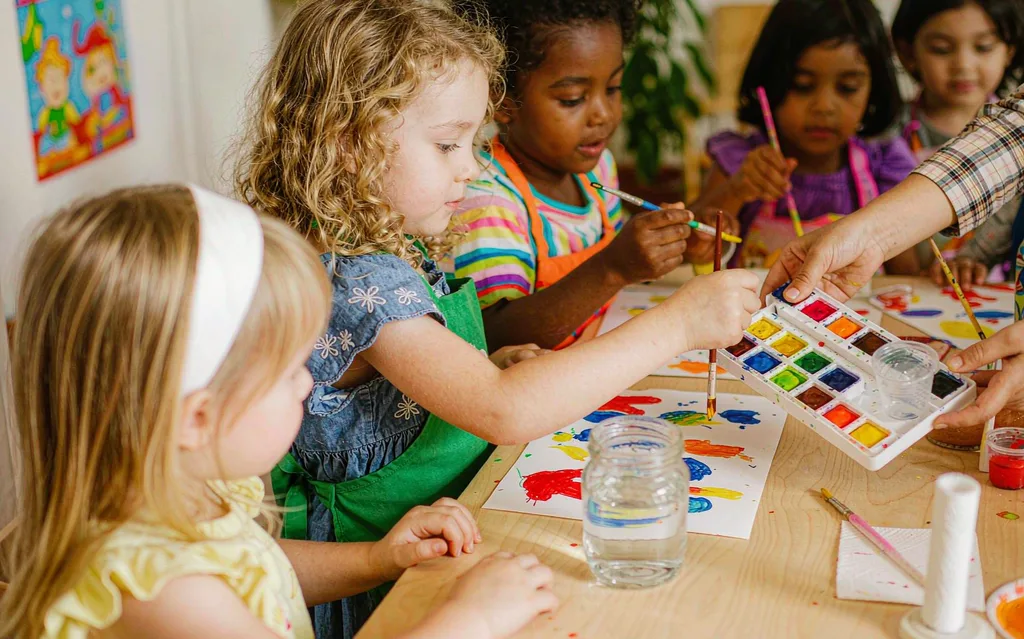
Preschool children painting with a watercolor set
Why Watercolor Is the Ideal First Paint for Preschoolers
Before comparing products, it helps to understand why watercolor deserves its place at the top of the preschool art shelf. Unlike acrylics or oils, watercolor is inherently low-stakes. A spill wipes away, a mistake fades into the paper, and clothing survives most encounters. That low-stakes quality matters enormously for young children, because it frees them to experiment. A four-year-old who is worried about ruining the table paints defensively; a four-year-old who knows mess is welcome paints boldly.
Watercolor also teaches genuine technique in miniature. Children discover that adding water makes colors lighter, that mixing blue and yellow creates green, and that a wet brush behaves differently from a dry one. These are real lessons in cause and effect, delivered through play. Finally, watercolor sessions are short. Preschool attention spans rarely survive a project that takes an hour to set up and an hour to clean; watercolor offers a five-minute setup and a two-minute cleanup, which is exactly the rhythm young children need.
What Separates a Good Preschool Watercolor Set from a Bad One
Not all watercolor painting sets marketed at children are equal. Some are genuine art tools scaled down for small hands; others are party favors with barely any pigment. When evaluating preschool art kits, check these fundamentals first.
Non-toxic certification is non-negotiable. Look for sets that conform to ASTM D-4236 in the United States or EN 71 in Europe. Preschool children will eventually taste a paint brush — it is practically a law of nature — so the paint itself must be certified safe. Reputable brands print certification marks directly on the packaging; if you cannot find one, treat the set as a decoration, not a supply.
Large color pans beat small ones. Tiny pans look generous in a 36-color set, but a preschooler’s brush cannot fit in them, and they crack or crumble under pressure. Sets with large, deep pans — even if they offer only eight or twelve colors — last far longer and produce richer color. Eight colors are plenty for young children; a smaller palette also simplifies color-mixing decisions.
Chunky, easy-grip brushes matter more than brush count. Fine detail brushes are useless for children still developing their pincer grasp. A good preschool set includes one or two short, thick-handled brushes, ideally with a triangular or bulbous grip that encourages correct finger placement. If the set includes only thin brushes, plan to buy a separate chunky brush.
Washability is a practical necessity. “Washable” on the label should mean the pigment lifts out of fabric with soap and water. Test this expectation early: paint a swatch on an old t-shirt and launder it. Truly washable formulas protect clothes, tablecloths, and the willingness of caregivers to say yes to painting sessions.
Sturdy cases survive real life. Preschool art supplies live chaotic lives — dropped from tables, crammed into art caddies, carried between rooms. A set with a solid clasp and a case that doubles as a paint-mixing tray will outlast three flimsy alternatives.
The Main Types of Kids Watercolor Supplies
Understanding the categories helps narrow the choice quickly. Most watercolor painting sets for young children fall into one of four types.
| Type | Best For | Strengths | Watch Out For |
| Solid pan sets | Ages 3–6, home and classroom | Easy setup, no spills, long shelf life | Cheap versions have weak pigment |
| Liquid watercolor | Group projects, process art | Brilliant color, great for droppers and spray bottles | Stains more readily; needs containers |
| Watercolor pencils | Ages 4–6 building pencil skills | Doubles as drawing tool; controlled application | Requires more coordination to blend |
| Complete art kits | Gifts, travel | All-in-one convenience, good value | Often padded with low-quality fillers |
Solid pan sets are the workhorse choice and the best starting point for most preschoolers. The child dips a brush in water, touches a pan, and paints — no pouring, no measuring, no chaos. Quality pan sets made for children use more pigment than party-grade versions, and the difference shows on paper within weeks.
Liquid watercolor is the secret weapon of many preschool teachers. A few drops in a cup produces intensely vivid paint, and it excels for activities like spray-bottle painting, dropper art, and dyeing paper towels. It is messier and better suited to supervised group settings than to independent table time.
Watercolor pencils occupy a lovely middle ground. Children draw normally, then brush water over the lines and watch their drawing “become paint.” For children aged five and up who are building pencil control, this bridge between drawing and painting is deeply satisfying.
Complete art kits bundle watercolor pans with crayons, markers, oil pastels, and paper. They make popular gifts and are convenient for travel, but inspect the contents: many budget kits include one good item surrounded by fillers. The watercolor component is usually the first thing to judge.
Matching the Set to the Child’s Age
Preschool spans several developmental stages, and the ideal set shifts along the way.
Ages 2–3 (early preschool). Choose the simplest possible setup: a six- or eight-color pan set with one chunky brush and thick paper. At this age the experience is about mark-making and color sensation, not technique. Avoid sets with tiny pans or more than a dozen colors.
Ages 3–4. An eight- to twelve-color pan set with easy-grip brushes is the sweet spot. Children this age begin naming colors deliberately and experimenting with mixing. A set that includes a built-in mixing tray in the lid earns its keep.
Ages 4–5. Capacity grows quickly now. Sixteen-color pan sets become usable, watercolor pencils enter the picture, and children can follow simple project ideas like painting a rainbow in order. Sets that include a small pad of watercolor paper help, because ordinary printer paper pills and tears when wet.
Ages 5–6. School-age kindergartners can handle liquid watercolor with droppers, finer brushes for simple details, and even beginner tube sets with supervision. This is also the age where a personal “artist kit” — a case they pack and own themselves — builds a sense of creative identity.
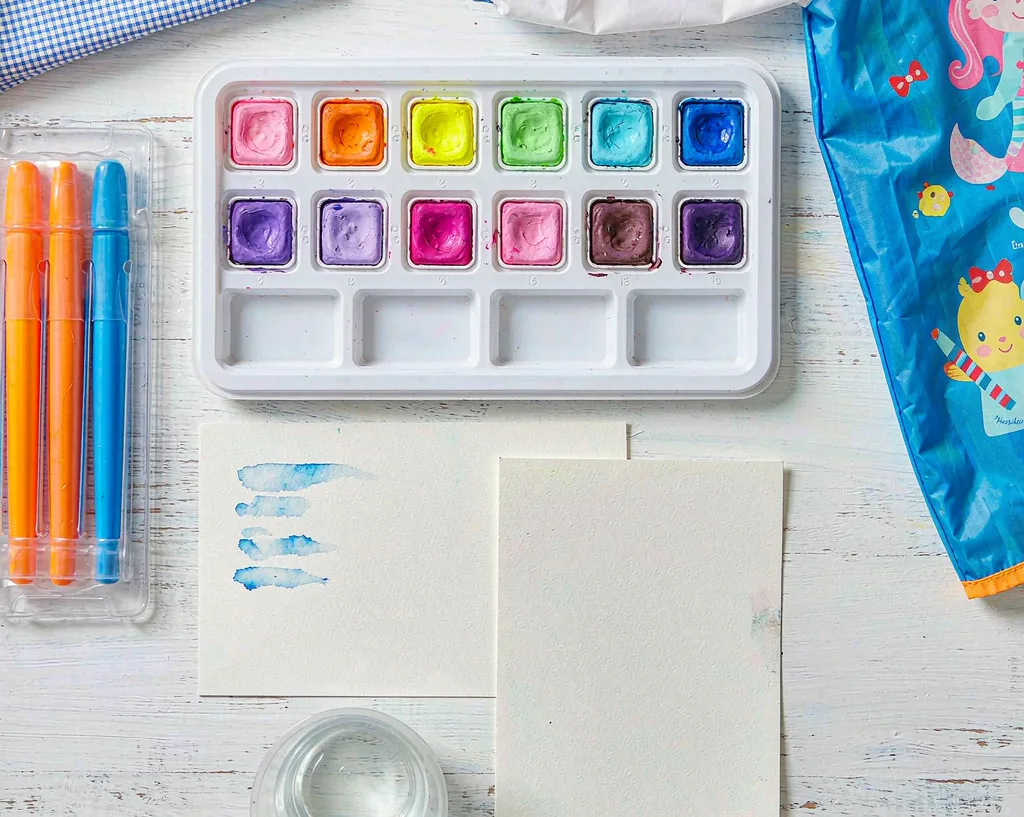
A typical children’s watercolor painting set
Setting Up Painting Sessions That Actually Happen
Even the best watercolor painting set fails if the environment fights it. A few setup habits turn watercolor from an occasional battle into a daily option.
First, keep a dedicated water jar and a stack of paper towels within reach of the table but out of the path of swinging elbows. Second, use real watercolor paper or a heavy mixed-media pad; the difference in how paint behaves is dramatic, and children notice. Third, embrace a “one brush, one jar” rule for the youngest painters to keep colors from turning to mud instantly — or teach the two-jar system, one for rinsing and one for clean water, as a badge of honor for older preschoolers. Finally, display the results. A rotating gallery of paintings on the fridge or a classroom wall tells children that their work matters, which fuels the next session.
Common Buying Mistakes to Avoid
The most frequent mistake is buying on color count. A 36-color set with pinhead pans delivers less painting joy than an 8-color set with generous, pigment-rich wells. The second mistake is skipping brush quality — a set is only as good as the brush that goes with it, and adult “please stop stabbing the paper” fatigue is real when the included brush is a splinter on a stick. Third, buyers often forget paper entirely, then wonder why paintings look dull and buckle. Budgeting a few dollars for a genuine watercolor pad improves every session. Lastly, avoid sets with clever but fussy mechanisms — twist-up gels, cartridge systems, refill pods — for this age group. Simplicity is a feature, not a compromise.
Frequently Asked Questions
Are watercolor paints safe if a child licks the brush? Certified non-toxic watercolors (ASTM D-4236 or EN 71) are formulated to be safe if accidentally ingested in tiny amounts. Teach “brushes are for paper” gently, but do not panic.
What paper works best for preschool watercolor? Look for “watercolor paper” or heavy mixed-media paper around 90 lb (200 gsm) or thicker. It absorbs water without buckling and lets colors stay bright.
How do I remove watercolor stains from clothing? Rinse in cold water as soon as possible, then launder with regular detergent. Truly washable children’s formulas lift out with this routine.
Pan sets or liquid watercolor — which should I buy first? Start with a pan set for independent painting, and add liquid watercolor later for group art and special effects.
The Bottom Line
The best watercolor painting set for a preschool child is not the biggest or the most colorful one — it is the one a three-year-old can open alone, a four-year-old can grip comfortably, and a five-year-old can grow with. Choose certified non-toxic paint, large pigment-rich pans, chunky easy-grip brushes, and a case that survives being loved roughly. Pair the set with real watercolor paper and a mess-friendly setup, and you have given a child something rarer than a toy: a reliable doorway into making things with their own hands. For anyone sourcing kids watercolor supplies — whether for a home art corner, a preschool classroom, or a gift shelf — that simple formula outperforms any flashy box on the store shelf.