
Flat paper is where most children’s creativity begins — crayon drawings, cut-out snowflakes, folding fans. But somewhere between the coloring page and the screen sits a category that turns flat paper into castles, animals, rockets, and whole small worlds: the 3D paper craft kit. These kits, which supply pre-cut pieces, folds, tabs, and instructions for building dimensional paper models, have quietly become one of the most educationally rich activities a child can do at a table. Far from being “just paper,” they exercise a remarkable range of creative and cognitive skills at once. This article explores exactly how 3D paper craft kits help children develop creative skills, why educators keep reaching for them, and how to choose kits that stretch a child’s abilities without snapping their patience.
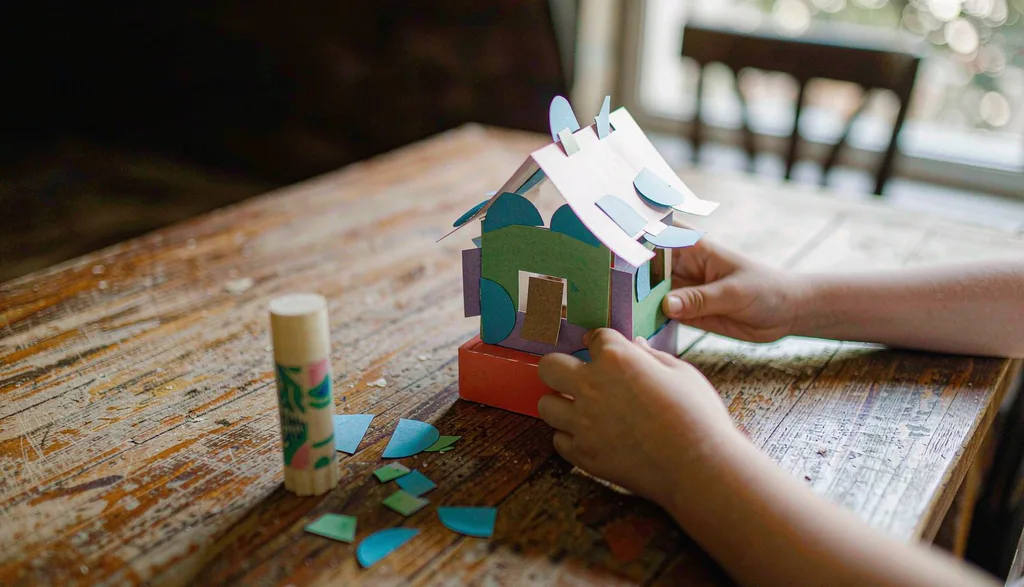
A child assembling a 3D paper craft model
From Flat to Formed: What Makes 3D Paper Crafting Different
Cutting, coloring, and stickering are two-dimensional activities: the child works on a surface. 3D paper crafting is different in a fundamental way. The child must imagine a flat shape becoming an object — then make that transformation happen with their own hands. A scored square becomes a cube. Six identical triangles become a pyramid roof. This mental leap from representation to construction is the seed of design thinking, and children experience it directly, with glue under their fingernails.
That transformation also creates a feedback loop that flat crafts rarely offer. When a fold is wrong, the tower leans. When a tab is not glued, the wall falls over. The object itself tells the child, immediately and without scolding, that something needs adjusting. Learning to read that feedback — to look at a leaning paper tower and think what should I change? — is the essence of creative problem-solving.
The Skill Stack: What a Paper Model Actually Trains
A single session with a well-designed 3D paper craft kit exercises a surprising stack of skills. Educators often describe paper modeling as “invisible gymnastics” for a child’s developing mind.
Fine motor strength and precision. Folding along a line, squeezing glue onto a small tab, and holding two pieces together while they bond all refine the small hand muscles that later control a pencil. For preschoolers and early elementary children, paper crafting is handwriting practice disguised as play.
Spatial reasoning. Turning a 2D template into a 3D object requires the child to rotate shapes in their mind — understanding that this circle will become a cone, that these flaps will meet behind the wall. Research on early STEM learning consistently identifies spatial reasoning as a predictor of later mathematics achievement, and hands-on construction is one of its best natural trainers.
Sequencing and planning. Real paper models have an order of operations. Gluing the roof before the walls invites collapse; skipping a fold creates a stubborn corner later. Children learn to read instructions ahead, plan the next two steps, and — a milestone moment — start caring about doing things in the right order without being told.
Patience and frustration tolerance. Paper is honest and occasionally unforgiving. A model that rips teaches gentleness; a tab that will not stick teaches persistence. Because materials are cheap and retry is easy, the stakes stay low while the resilience lesson stays real.
Creative confidence. Most importantly, the finished model is proof. The child did not watch a video of a castle; the child built a castle. That evidence — I can turn ideas into objects — is the psychological foundation every creative skill is built on.
Creativity Beyond the Instructions
A common worry about kits of any kind is that they are too prescriptive — the child just assembles someone else’s design. In practice, 3D paper craft kits sit at a sweet spot between structure and freedom. The pre-cut, engineered framework removes the tedious failures (imprecise cutting, collapsing geometry) that frustrate young builders, while leaving generous creative surface: color choices, decoration, arrangement, storytelling.
A kit that builds a paper house is rarely “finished” when the last tab is glued. It becomes a dollhouse for figurines, a setting for a story the child invents, a component of a paper village built across a week. Finished models accumulate into collections, displays, and imaginary worlds — and that extension play is where the deepest creativity lives. A good kit does not end imagination; it gives imagination an object to orbit.
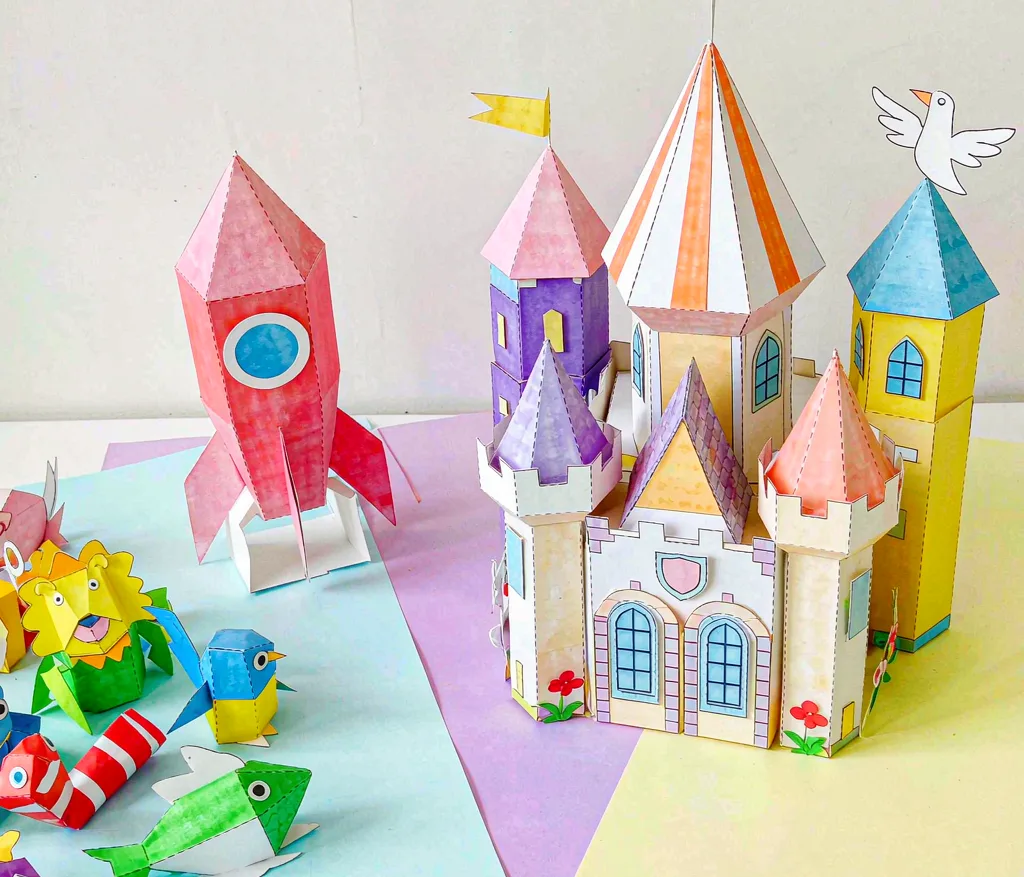
Finished 3D paper craft models
Matching Kits to Age and Ability
Not all 3D paper craft kits suit every child, and the right difficulty level matters more here than in almost any other craft category. A kit that is too hard produces tears and a half-built wreck; too easy produces five minutes of mild interest.
| Age | Best Kit Style | Skills Being Stretched |
| 3–4 years | Pre-scored, large-piece models; minimal tabs; adult assembles the tricky joins | Folding awareness, gluing, colors, cause and effect |
| 5–6 years | Simple animals, vehicles, and houses with 5–15 pieces | Precise folding, sequencing, independent completion |
| 7–9 years | Multi-part models, moving elements, pop-up mechanisms | Planning, spatial rotation, following multi-step diagrams |
| 10+ years | Complex architecture, mechanical paper engineering, own designs | Advanced geometry, patience, original design thinking |
Two signs a kit is well-matched: the child can complete a meaningful portion independently, and the child wants to keep or play with the result. If every session requires an adult to do the hard parts, step down a level; if the model is assembled in ten minutes and forgotten, step up.
How to Choose a Quality 3D Paper Craft Kit
The market ranges from superb engineered kits to thin party favors, and a few checkpoints separate them.
Pre-cut beats cut-it-yourself for younger children. Press-out pieces that pop cleanly from the card keep the focus on building rather than on scissor endurance. For older children, kits that include some cutting add legitimate skill practice.
Look for pre-creased or pre-scored folds. Crisp fold lines are the difference between a satisfying snap-fold and a ragged, frustrating bend. Quality kits score their card so young fingers can fold accurately.
Check the instruction style. The best kits use numbered, picture-based diagrams with minimal text — accessible to pre-readers and to children across language backgrounds. Beware kits whose “instructions” are a photo of the finished model.
Count the glue. Is a glue stick included? Are the tabs generous enough to actually hold? Under-engineered joins are the number-one complaint in reviews of cheap kits.
Favor themes the child can extend. Animals, vehicles, dollhouses, and castles invite ongoing play; abstract shapes are beautiful but leave less for the imagination to grip.
The Adult’s Role: Help Without Taking Over
The educational payoff of a 3D paper craft kit depends heavily on how adults behave during the build, because the line between supporting a child and replacing a child is surprisingly easy to cross. Well-meaning parents routinely take over the fiddly folds “to help,” and in doing so quietly convert a creativity exercise into a ten-minute show. The more productive stance is scaffolding: the adult manages the environment while the child manages the model.
In practice this looks like reading the instructions aloud together but letting the child decide what step comes next; holding the model steady when asked but not steadying it unasked; normalizing errors by narrating your own (“this tab tore — let’s tape it and keep going”); and asking process questions rather than correction questions. “Which piece do you think connects here?” builds spatial reasoning. “That wall is leaning — what could we change?” builds engineering instincts. Teachers using paper construction kits in classrooms report a useful rule of thumb: hands behind the back unless invited. It feels awkward for about five minutes, after which most adults discover how capable children are when no one is hovering. The goal of every kit session is the same — an adult who is gradually needed less, and a child who gradually believes more.
Tips for Parents and Teachers
A few habits multiply the value of any 3D paper craft kit. Work on a clear, covered table so pieces stay findable and glue stays where it belongs. Let the child lead the sequence even when the “correct” order seems obvious — discovering why the roof goes on last is worth one collapsed house. Resist the urge to fix wobbly parts immediately; hand the problem back with a question: “What could hold that wall up?” Display finished models on a shelf rather than a fridge, where three dimensions can be admired from all sides. In classrooms, rotating a “building challenge” table — this week a bridge, next week a tower — turns a craft activity into a STEM station. And keep finished kits: a shelf of self-built paper animals is a child’s visible résumé of competence.
Frequently Asked Questions
What age is right for 3D paper craft kits? Most suit ages 4 to 10. Choose press-out, large-piece models for preschoolers and multi-part engineered kits for older children, following the box’s age guidance.
Do these kits actually help with school skills? Yes. The folding and gluing refine fine motor control, while the flat-to-3D construction builds spatial reasoning — both foundational for handwriting and mathematics.
What if my child gets frustrated when a model tears? Keep tape within reach and treat repairs as part of building. Low-stakes fixing is itself a creativity lesson: broken things can be solved, not just discarded.
Are they good classroom activities? Excellent ones. They are inexpensive, low-mess, quiet, and naturally differentiate — faster builders can decorate or extend while others finish.
How long does a typical 3D paper model take to build? Simple preschool models take 15–30 minutes, mid-range kits for ages 5–8 run 45–60 minutes, and complex paper-engineering sets for older children can fill a whole afternoon — which makes it worth checking the piece count before choosing a kit for a specific occasion.
The Bottom Line
3D paper craft kits succeed where many activities merely entertain: they convert a child’s natural love of making into a structured workout for the skills creativity depends on — fine motor precision, spatial thinking, sequencing, persistence, and the confidence of having built something real. The paper is cheap, the mess is small, and the payoff is a shelf full of objects a child built with their own hands and can play with for weeks. Choose kits with clean pre-cut pieces, honest fold lines, and themes that invite continued play, match the difficulty to the builder, and then step back. The castle the child builds next will be entirely their own work — and that is exactly the point.