
Every holiday season, toy aisles fill with flashing electronics and screen-adjacent gadgets — yet the quiet bestsellers beside them are boxes of pom poms, safety scissors, glue sticks, and pre-cut felt. DIY art and craft kits have become one of the most reliable categories in the children’s gift market, stocked by supermarkets, bookstores, museum shops, and online sellers alike. The popularity is not an accident. It sits at the intersection of what parents want for their children, what gift-givers need at the checkout, and what retailers have learned to merchandise brilliantly. This article unpacks the real reasons behind the boom in children’s creative kits and kids gift craft sets — and what that means for anyone buying, giving, or selling them.
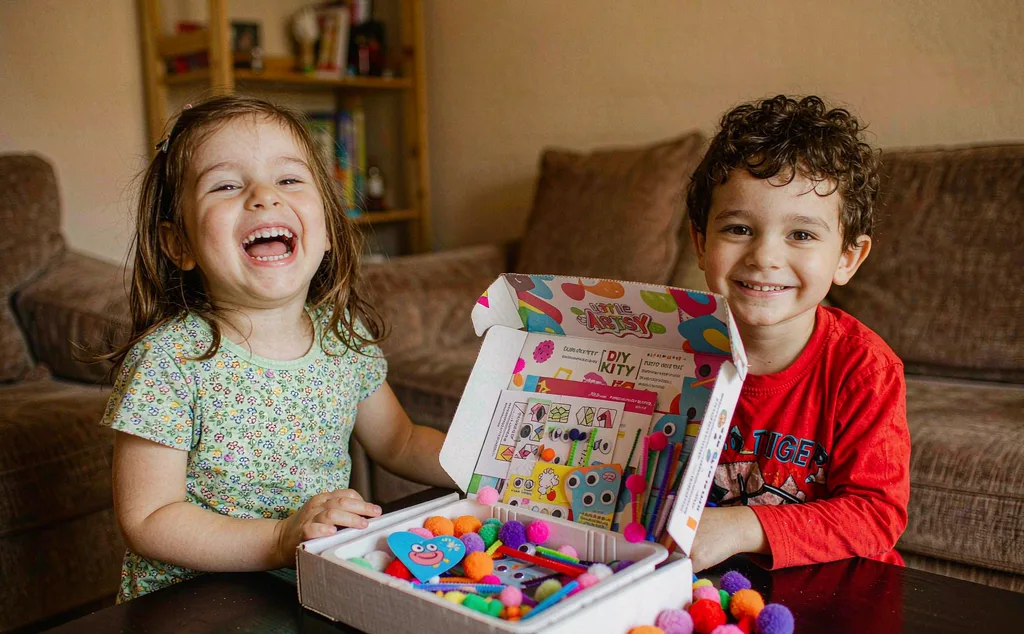
Children opening a DIY craft kit gift
The Screen-Free Backlash Is Real
The single strongest force behind the craft kit boom is a widespread parental desire to pull children away from screens. Pediatric guidance in many countries recommends strict limits on recreational screen time, and most parents feel the daily tension between a tablet’s convenience and their own better judgment. A DIY craft kit offers a perfect counterweight: it occupies a child’s hands and attention for a meaningful stretch of time without a single notification.
Unlike many open-ended toys, a craft kit has a built-in finish line. A child opens the box, follows the steps, and produces a bracelet, a painted suncatcher, a sewn plush, or a model dinosaur. That arc — begin, focus, complete — is deeply satisfying for children and, just as importantly, visibly productive to parents. Twenty minutes of focused making looks like success in a way that twenty minutes of scrolling does not. Gift buyers understand this instinctively, which is why “screen-free” has become one of the most common phrases on craft kit packaging and product listings.
The Psychology of Making: Why Children (and Parents) Love Kits
Beyond screen avoidance, DIY art and craft kits deliver something children genuinely crave: competence. Developmental psychologists have long noted that children are driven to master real skills, and craft kits package mastery into achievable steps. Threading a bead, folding a paper crane, or stitching a first seam gives a child proof — a physical object — that effort produces results.
For parents, the appeal is layered:
- Developmental value. Crafting builds fine motor control, hand-eye coordination, sequencing ability, and sustained attention — skills that transfer directly into handwriting and early math.
- Convenience. Everything needed is in the box. No Sunday-night scramble for supplies, no half-finished projects abandoned because the right glue was missing.
- Quality time. Many kits are designed for an adult and child to complete together, turning a gift into a shared experience rather than another solo activity.
- Emotional regulation. Focused handwork is naturally calming. Teachers and occupational therapists use craft activities precisely because they settle busy minds.
A gift that promises skill-building, family bonding, and calm — all for the price of a mid-range toy — is an easy story for a gift-giver to believe.
Why Gift-Givers Reach for Craft Kits
Ask anyone who has shopped for a child they do not know well — a niece, a classmate, a colleague’s daughter — and the same anxiety appears: will the gift be right? Kids gift craft sets solve this problem in several ways at once.
They are age-labeled and self-explanatory. A box marked “Ages 5+” containing a jewelry-making kit communicates instantly what it is and who it suits. There is no size, no character franchise, no gender trap to navigate as carefully as with dolls or action figures.
They suit almost any child. Craft kits span enormous territory — painting, sewing, beading, clay, slime, woodwork, sticker mosaics — so there is a kit for the builder, the artist, the collector, and the dreamer alike.
The price points are ideal. Most quality craft kits sit between 10 and 30 dollars, squarely in the sweet spot for birthday party gifts, holiday stocking fillers, and reward presents. A giver can look generous without overspending.
They produce a keepsake. When a child gives a hand-painted picture frame back to the grandparent who gifted the kit, the gift has created a second moment of joy. Few toys offer that return journey.
They travel well across borders and family structures. A craft kit needs no translation, no power adapter, and no shared culture of a character franchise to be understood. This makes children’s creative kits a standout choice for international gift-giving — the grandparent mailing a box overseas, the expat family attending a local birthday party — and for the many modern households where a gift needs to work for any child, in any home, with whatever adult happens to be on duty.
The Retail Logic: Why Stores Love the Category
From the seller’s side, children’s creative kits are nearly perfect merchandise. They are lightweight, compact, and inexpensive to ship, which makes them ideal for e-commerce margins. They have long shelf lives with no batteries to expire or electronics to fail. And they photograph beautifully — a flat lay of vibrant craft components is social-media-ready marketing for free.
Retailers have also refined how they sell the category. Craft kits anchor seasonal displays for Christmas, Easter, rainy-day promotions, and summer travel (“airplane-friendly activities”). They fill the enormous birthday-party-gift market, where parents buy multiples throughout the year. Subscription boxes extended the model into recurring revenue, turning a one-time gift into a monthly arrival that many families treat as a craft club in a cardboard envelope. For manufacturers, the format is flexible: a successful concept — say, a gem-art kit — can be re-skinned season after season with new themes, keeping production lines efficient while the catalog feels fresh.
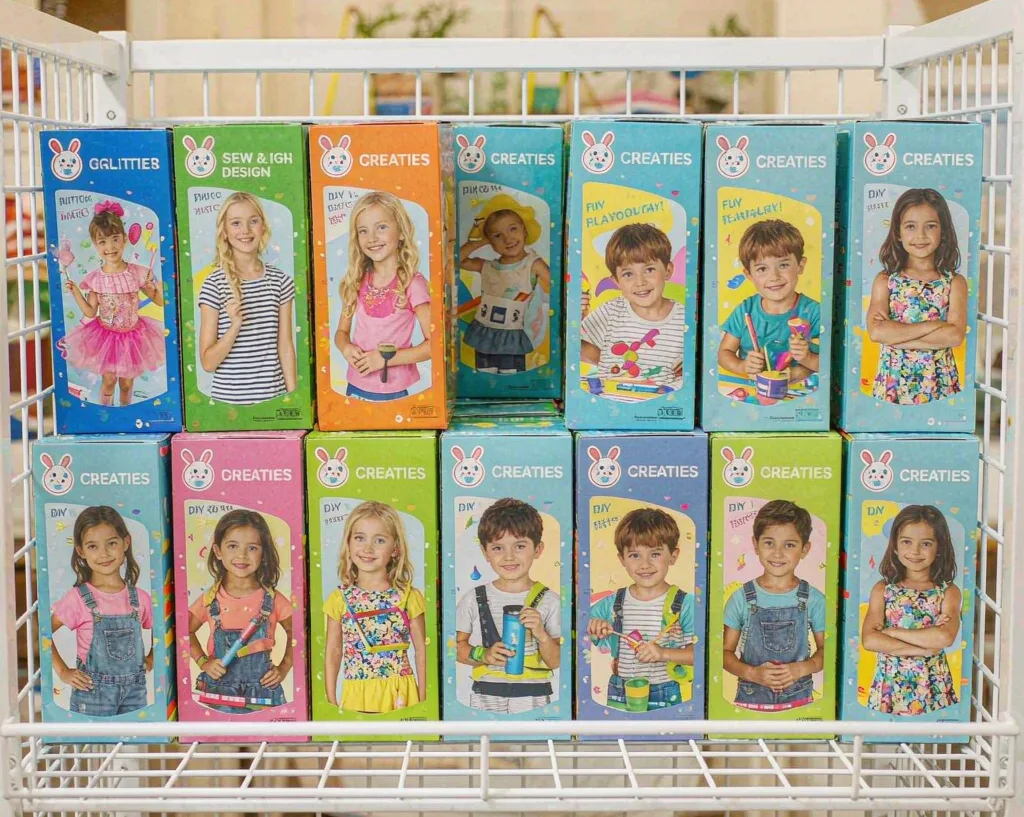
Craft kits displayed in a gift store
What Separates a Good Craft Kit from a Forgettable One
The category’s popularity has a downside: the market is crowded with kits that disappoint. Parents talk, and reviews punish kits with flimsy materials, unclear instructions, or projects that fall apart by bedtime. The kits that earn repeat purchases share recognizable traits.
| Quality Marker | What to Look For |
| Complete contents | Every component included — no extra shopping trip required |
| Clear instructions | Picture-based steps a pre-reader can follow with a parent |
| Honest age labeling | Challenging enough to engage, easy enough to finish |
| Durable materials | Real wood, thick card, quality cord — not brittle plastic |
| A satisfying result | A finished item the child actually wants to keep, wear, or gift |
The “satisfying result” marker deserves emphasis. Kits that end in something displayable — a necklace, a wind chime, a painted birdhouse — generate far more enthusiasm than kits that end in a glued-together shape destined for the recycling bin. The best kits even build the giving loop into the product: decorate-this-box-for-your-friend designs turn the craft itself into the next gift, which is marketing genius hiding inside a children’s activity.
Party Favors, Return Gifts, and the Events Market
A significant share of craft kit sales never appears under a Christmas tree at all. Children’s birthday parties have become a major engine for the category, in two directions at once. As main gifts, craft kits are a safe choice when a parent asks the classic question “what does your child like?” and the honest answer is “anything quiet.” As party favors and return gifts, mini craft kits have largely replaced the plastic goody bag: a small kit that each guest completes at the party doubles as entertainment and as the take-home present. Event planners now build entire parties around a single kit theme — gem art for six guests, sand art for eight — which turns the product into an activity service. The same logic extends to classrooms (end-of-term gifts), holiday events at libraries and museums, and restaurant activity packs. Each of these channels buys in multiples, which is precisely what manufacturers and retailers love: a category that sells one at a time is a product, but a category that sells eight at a time is a business.
How the Category Is Evolving
The DIY craft kit market keeps reinventing itself, and several trends explain why it continues to grow rather than plateau. Eco-conscious kits using recycled card, natural fibers, and plastic-free packaging appeal strongly to millennial parents. STEAM-flavored kits — think circuit-building greeting cards or crystal-growing paintings — let the category borrow credibility from educational toys. Personalization is another growth engine: kits that produce name banners, custom jewelry, or self-portrait puzzles give children the thrill of making something uniquely theirs. Meanwhile, social platforms keep feeding demand, as parents share satisfying craft-process videos that quietly function as the industry’s best advertising.
Frequently Asked Questions
What age is best for DIY craft kits? Most kits suit ages 4 to 10, with the sweet spot around 5 to 8 — old enough to follow steps, young enough to find the magic irresistible. Always check the box labeling rather than assuming.
Are craft kits good gifts for children who “already have everything”? They are among the best options. A consumable experience that ends in a keepsake rarely duplicates anything in an already-full toy box.
How long should a good craft kit take to complete? Thirty to ninety minutes is ideal for most children: long enough to feel substantial, short enough to finish in one sitting.
Do craft kits make good party favors? Yes — they are arguably the modern replacement for the plastic goody bag. A small kit doubles as a party activity and a take-home gift, and parents receiving them generally prefer it.
What should I check before buying a kit online? Look at recent reviews mentioning material quality and instruction clarity, confirm the kit includes all components, and verify the age recommendation matches the child.
The Bottom Line
DIY art and craft kits dominate children’s gift markets because they satisfy everyone at the table. Children get the deep satisfaction of making something real; parents get screen-free focus, developmental value, and quality time; gift-givers get an affordable, universally appealing present that cannot be wildly wrong; and retailers get a lightweight, evergreen, endlessly re-themeable product. The kits that thrive are the ones that respect the child — complete contents, honest difficulty, durable materials, and a finished treasure worth keeping. For anyone choosing a gift in this crowded category, that simple test — will the finished object matter to the child? — separates the boxes that get opened twice from the ones that get remembered for years.